
Moneyball Before Moneyball
How Earl Weaver used analytics decades before analytics

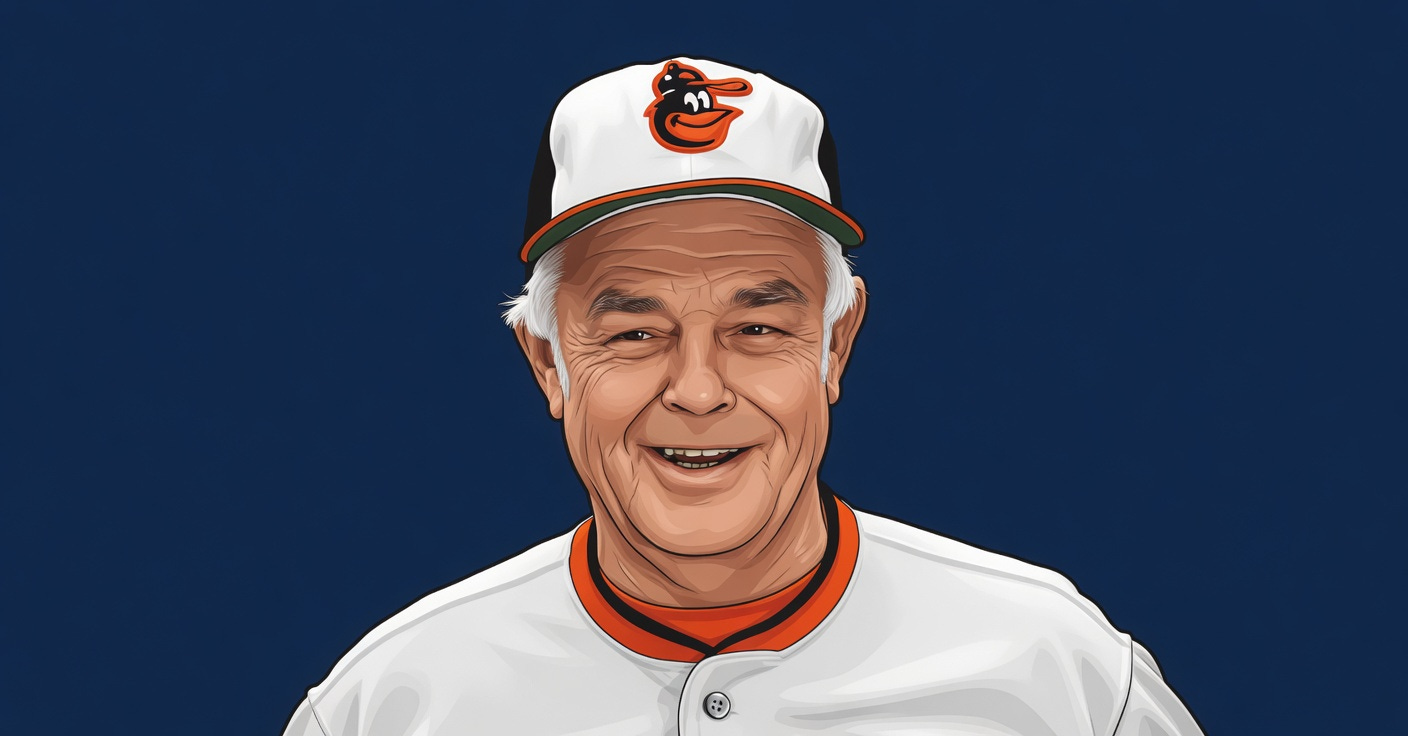
Earl Weaver is mentioned once in Moneyball.
Here’s what it says:
“Bill James’ analysis was consistent with an approach to the game championed most vocally by the former manager of the Baltimore Orioles, Earl Weaver. Weaver designed his offenses to maximize the chances of a three-run homer. He didn’t bunt, and he had a special taste for guys who got on base and guys who hit home runs. Big ball, as opposed to small ball.”
Now let me tell you the real story — the one Michael Lewis willingly overlooks.
Across two stints as manager of the Orioles (1969-1982, and 1985-1986), Earl Weaver amassed a record of 1,480 wins and 1,060 losses.
Between ‘69 and ‘82, no team in Major League Baseball came within 70 wins of Weaver’s win total over that timespan.
Across the full seventeen seasons of his managerial career, Baltimore won 90+ games eleven times, and 100+ games five times. The Orioles won six division titles, four American League pennants, and won the World Series in 1970.
Since divisional play was introduced in 1969, Weaver’s .583 win percentage is the highest of any manager with over 1,000 wins.
And he did it by being the first manager in baseball to use data aggressively.
Not only did Weaver intuitively arrive at many of the same approaches to the game as the Moneyball-era Oakland Athletics, he also pre-empted many of the current-era approaches too.
In his book — which came out 20 years before Moneyball — Weaver explains his penchant for statistical analysis and how it fed his competitive drive.
“From the day I took over the Orioles I wanted all the statistical information I could get,” he writes. “Maybe I wouldn’t use everything, but I wanted to see it. I believe that what you don’t know can hurt you and that you can never know enough.”
Weaver built a systematic matchup database which would tell him how his batters had fared against each pitcher, and how his pitchers had fared against the opponent’s batters. “On the day of a game the first thing I did when I arrived at the park was to examine the sheet showing how our hitters performed against that night’s starting pitcher,” Weaver writes.
Pitching First
“When people ask me to simplify my approach to baseball,” Weaver writes, “I often reply that the way to win is with pitching and three-run homers. While everyone knows how much I love the home run, notice that I mention the word pitching first. Pitching is the most important part of the game.
During his tenure with the Orioles, the club had a 20-game winning pitcher for thirteen straight years. In 1971 alone, they had four 20-game winners on their roster. Weaver knew how to both scout and develop pitching talent.
Primarily, he looked for two things: can he throw hard, and can he throw strikes?
To help, Weaver was the first manager to make extensive use of a radar gun. During home games, the Orioles would use the radar gun on their own pitchers to measure velocity, but also look for declines in speed in order to predict tiredness. They would also use the gun on opposition pitchers and relay the velocity to Oriole hitters before they went to the batters box.
(Throwing hard is about as contemporary an approach to pro baseball as you can get, as evidenced by recent events in the MLB)


Runs Win Games
“The home run is my favourite subject,” Weaver writes in his chapter about offense.
“On a home run, nothing can go wrong,” he continues. “You can’t be robbed by a fielder making a great catch or by your baserunner falling down or by someone being thrown out. Why people can’t see that, I’ll never know.”
Weaver’s obsession with home runs wasn’t just because it’s the most exciting play in baseball — although he does acknowledge the entertainment value. Rather, Weaver’s love of the home run is because he loves winning baseball games, and runs win baseball games.
“In my mind, the home run is paramount, because it means instant runs,” he says. “The minute you hit a homer you have a run, no questions asked. With anything else, you aren’t guaranteed a run.”
In Weaver’s first full season managing the Orioles, they scored 779 runs — 200 more than the season before. In his second full season they went even further, scoring 792 runs en route to winning the World Series.
Runs win baseball games — and Earl Weaver knew it 8 years before Bill James had even begun self-publishing his Baseball Abstract.
In particular, Weaver was fond of the three-run home run, and it was this approach that led to people first deciding he was ‘smart’. But he saw it as a fundamental truth of the game rather than his own intelligence.
“The power of the home run is so elementary that I fail to comprehend why people try to outsmart this game in other ways,” he says. “If I were to play a singles hitter in right field, he’d have to hit well over .300 and get on base often to be as valuable as a twenty-five-homer man.”
The Value Of Outs
One of the largest corrections caused by the analytics era in baseball has been the value of an out. In Moneyball, Michael Lewis went to great lengths to describe Oakland’s attempts to change the mindset around throwing away your outs.
Twenty years earlier, Early Weaver was ahead on that, too. He put it this way: “Your most precious possessions on offense are your twenty-seven outs.”
Weaver believed that bunting was rarely worth the trouble, and that for a sacrifice bunt, the clue was in the name: “Sacrifice means you are giving up something. In this instance, you’re giving up an out to the opposition. There are only three an inning, and they should be treasured.”
He held similar views about stolen bases: “In theory, the stolen base is a good weapon, but everything depends on how often it works. For the steal to be worthwhile, the runner should be safe around 75 percent of the time.”
And despite his penchant for big ball over small ball, Weaver recognized the value of the walk: “There is a lot to be said for the base on balls. It isn’t as good as a hit, especially when that hit is a double or a homer, but there are certain guys who can mean a lot to your offense because they draw walks.”
This strategy was underpinned by one of Weaver’s key philosophies of baseball: don’t play for one run unless you know that run is going to win the game. His caveat, though, was that bunts and walks and steals can make sense if you have a player who is truly capable at that skill — like Rickey Henderson with stealing bases.
Building An Aggregate Player
In one of the more famous scenes in the Moneyball movie, Billy Beane and Peter Brand sit with the scouts and try to figure out a strategy to replace three outgoing superstars.
Beane says to his staff: “You’re still trying to replace Jason Giambi, whose on-base percentage was .477. We can’t do it. But what we might be able to do, is recreate him in the aggregate.”
Across the three outgoing superstars, they find that the collective on-base percentage is 1.092.
1.092 divided by three players equals .364.
So the task becomes not to replace Giambi’s .477 (which would be too expensive) but to find three players capable of an on-base percentage of .364 (much cheaper).
Or…as Earl Weaver puts it: “By matching your bench-players’ strengths to your starters’ weaknesses, you can create a ‘player’ of All-Star caliber from spare parts.”
Undervalued Talent
Michael Lewis wants you to believe that YaleBros reinvented baseball. In reality, it was a coach who reinvented baseball.
The real story isn’t that ‘smart’ economics grads from Ivy League schools saw something that the ‘dummies’ in baseball had never thought about.
Rather, the real story is of a high school graduate from a rough part of St. Louis, with a drinking problem and a fiery temper, who used statistics to win more baseball games than anyone else in his era.
Brad Pitt may not play him in a movie, but that doesn’t make Earl Weaver’s story any less Hollywood.
Weaver’s is the ultimate story of uncovering undervalued talent. It’s just that he’s the undervalued talent.
Cody’s Notes
Here is what Tom Verducci wrote about Earl Weaver in Sports Illustrated in 2009: “Just as Copernicus understood heliocentric cosmology a full century before the invention of the telescope, Weaver understood smart baseball a generation before it was empirically demonstrated.”
John W. Miller’s recent biography, The Last Manager, rightfully places Weaver back in his rightful position as ‘the grandfather of the modern game’.
PS: if you’re receiving this and you’ve previously unsubscribed from my newsletter, I want to apologize. As I migrated my newsletter from Beehiiv to Substack, my subscriber list pulled over everyone who has ever subscribed. I’ve tried to manually remove the unsubscribers one-by-one, but I’m sure I’ve missed a few. If that’s you: sorry.