
Temporary Insanity
How Pat Riley planned his outbursts

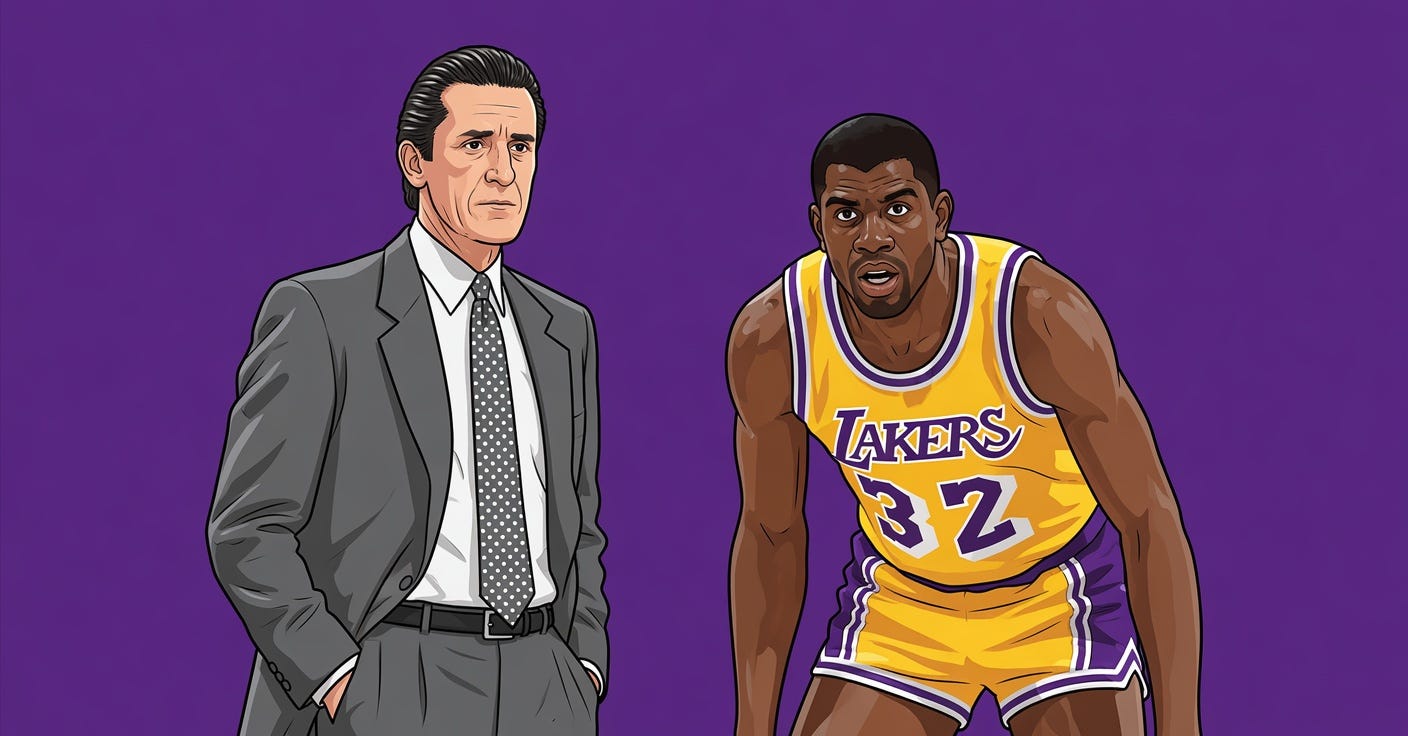
Pat Riley is known around the NBA as ‘the Godfather’.
He has nine championship rings — one as a player, one as an assistant coach, five as a head coach, and two as an executive.
Riley burst onto the scene as a head coach, winning four titles in his first seven seasons (they lost in the NBA Finals in two of those years). Later in his career, in a span of eight seasons, Riley won three NBA Coach of the Year awards with three different franchises — the Lakers, Knicks, and Heat.
(A little known fact about Riley is that he was drafted as a wide receiver by the Dallas Cowboys in 1967).
Fast forward to today, and Pat Riley’s fingerprints are still all over the NBA. As president of the Miami Heat, he presides over what’s been termed the ‘Heat Culture’, a commitment to standards, discipline, and accountability. Players that don’t adhere are shipped out.
This stands out in the modern NBA where many teams lack the strength of leadership to bother implementing any sort of consistent culture. Riley’s stature, consistency, and longevity have helped enable Miami to create an environment that consistently competes at the top end of the league.
Former Heat player Meyers Leonard explained the culture this way: “Everyone thinks, 'Oh, it's so militaristic and hard-nosed.' No, the Heat just want a level of professionalism. But truly, at heart it's loyal, caring people.”
Riley’s book, The Winner Within, was written before he joined the Heat as head coach, but you can see the underlying philosophy in his early writings.
The book is famous for coining the term ‘The Disease of Me’, the idea that after winning, individuals often adopt a toxic, self-serving attitude that diminishes from the team-first mentality that allowed them to win in the first place.
I wrote about this phenomenon in my post on Sarina Wiegman, which you can read here:

Rather than go over old ground, I want to focus on another concept that Riley coined, one which he understood more precisely than anyone gives him credit for.
Temporary Insanity
In his chapter, fittingly titled ‘Mastery’, Riley talks about skillfully and thoughtfully using emotional outbursts to shake his team out of a funk.
In 1987, the Lakers went on a 9-1 streak after the All Star break. But when they arrived in Salt Lake City to play the Utah Jazz, Riley sensed something was wrong.
“It was only 10am, but the players dragged through baggage claim and onto the team bus like it was the end of a double-shift day at the factor,” he writes. After a sullen practice, the team played a poor game, losing 100-107.
“I verbally ripped into the team with a passion that I hadn’t shown since we lost to the Celtics by 34 points in Game 1 of the 1985 NBA Finals,” Riley recalls.
He called them quitters — a term that no professional athlete wants to be known as. “You don’t owe me anything,” he shouted, “you owe each other. You quit on each other, out on the court, and that cost you the game.”
He kicked some ice bags on the way out, sending water and cubes everywhere. It was a deliberate plot to punctuate his displeasure.
Riley knew exactly what he was doing. He was giving the Lakers a shake:
“You see, no matter how much progress a team or an individual makes, no matter how much they lift their aspirations and their performance, old behaviour patterns will always try to prevail. You simply have to be wise to yourself. Catch it as early as possible and try to turn it around.”
There are ramifications for choosing this course of action, of course. At the next practice session, Riley says the players displayed a ‘lingering sense of estrangement’. He asked Magic Johnson for feedback on whether the spray had achieved its intent.
Johnson told him, “It was good and bad. Good because you got us thinking, bad because you scared the hell out of half the guys. Some of them don’t know you as well as I do, so their jaws hit the floor.”
Mission accomplished.
Riley writes, “The fact is that every moment of that Temporary Insanity was pre-thought in word and gesture. I never once pointed out any one individual. But the guys who were guilty of withholding effort thought I was talking straight to them.”
Crucially, Riley’s words took aim at their effort, and their supportiveness of each other — themes that were consistently in place for the Lakers throughout that season.
The Lakers went 21-1 after the Utah loss, finishing the season 10 games clear atop the Western Conference.
It’s important to note that Riley had already done the work to allow his outburst to work. There is research that angry speeches work when the coach isn’t angry all the time and doesn’t become completely unhinged — it refocuses attention and approach from players. But more importantly, Riley had already set a caring and challenging culture over a period of years.
“No attitude lecture can take the place of the environment that leaders create for their people,” Riley writes in a different section of his book, adding: “Compassion is vital. Without it, anger degenerates into brutality and tears the fabric of the team. As much as possible, a positive emotional environment has to govern the team.”
Even his term Temporary Insanity is carefully chosen…it’s temporary.
Pat Riley’s Temporary Insanity Textbook:
A leader’s aggrieved outburst is not an explosion, nor is it a regular or predictable event.
It is the art of being angry at the right time, to the right degree, with the right people.
Temporary Insanity requires plenty of advance thought — a real and focused mental plan, not emotion-driven monologue.
A dose of Temporary Insanity demands a rapid follow-up of compassion.
The Temporarily Insane leader should always send out someone to complete the damage report and to get a quick, accurate reading of the emotional wounding done by the rampage.
📨 I’m currently accepting new clients: If you'd like to work with me, send me an email (or DM me on social media) and we can organize a time to chat in more detail.